Last post I talked about amplifying DNA by real time-PCR, which measures the number of amplified copies at the end of each cycle, giving researchers "real time" numbers of DNA copies. To do this however, you need appropriate primers to get the job done. Not only do they have to be specific enough to work only for the DNA you want amplified, but I'm learning there are other tricks you need to abide by.

Let's back up a little bit though and look at transcription and translation. After all, I'm after the mRNA transcripts that are made in this process. With my
genetically engineered construct,
protein synthesis starts when transcription factors bind within the cloned 5' untranslated region (UTR) and begin transcription at the promoter, transcribing all of the way through the eGFP open reading frame (ORF) and through the 3' UTR. Now we have an mRNA transcript with part of the 5' and 3' UTR intact at either end of the eGFP coding region. This will serve as the template for translation, which begins at the start codon of the ORF and ends at the stop codon. The 5' and 3' UTR are not translated, hence their UTR moniker.
My project is aiming to measure the amount of mRNA transcript in cells under different environmental conditions. It's not easy to measure mRNA by itself, but it is very easy to measure DNA. Using mRNA as a template, you can make complimentary DNA using the enzyme reverse transcriptase.

Reverse transcriptase starts at the 3' end on an mRNA molecule and transcribes a complimentary strand backwards along the mRNA. However, reverse transcriptase will eventually fall off (represented by the fading orange triangle), so smaller mRNA transcripts work the best.
If I have this mRNA transcript that I want to
measure through RT-PCR (after I've converted it into cDNA with reverse transcriptase), I need a primer to amplify the eGFP coding region.
I first made this primer pair to test for the presence of eGFP in my diatom cell lines. It amplifies most of the eGFP coding region by attaching at points just inside of the gene, as you can see below.
Unfortunately, these primers aren't working very well when it comes to applying them to real time-PCR.

My control real time-PCR reactions have worked pretty well for me each and every trial I've run. The control reactions use primers to amplify the
endogenous genes we're manipulating in our system, which serve as a good comparison to the experimental reactions.
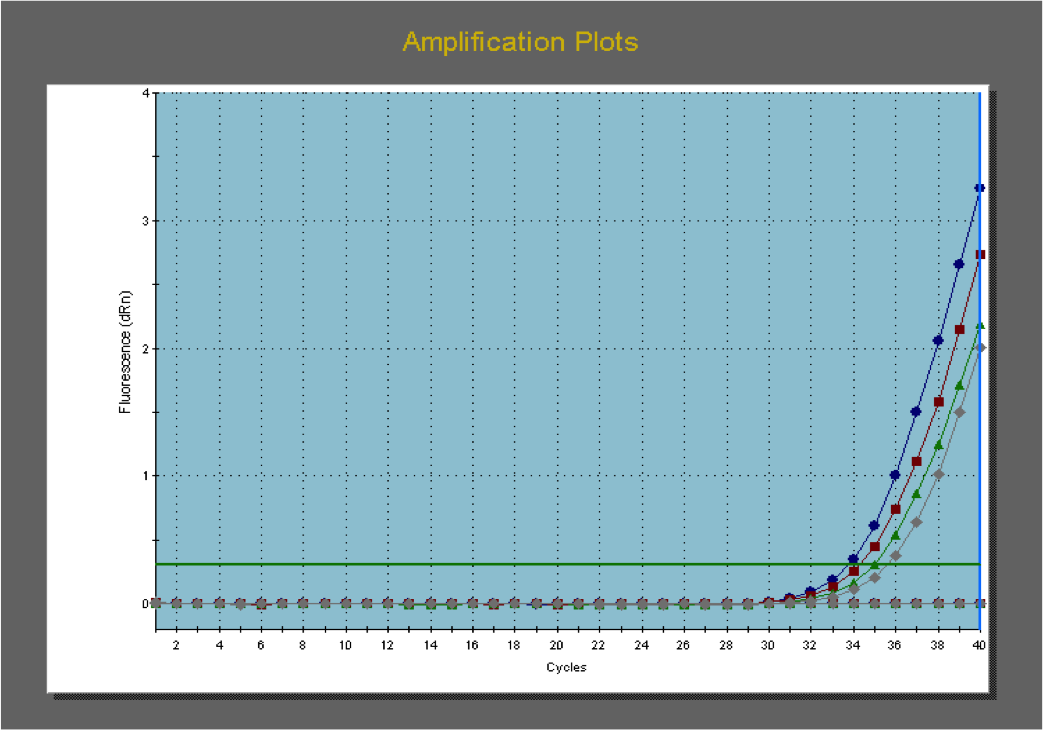
You can see on the graph at right that the primers amplifying endogenous genes work pretty well, developing curves within an appropriate cycle range (the number of cycles until a noticeable amount of product can be measured).

However, when I look at the graph for the transgenic lines using the above primers to amplify eGFP, I get a graph like this on the left. The amplification lines are severely delayed and do not approach the same level of product by the end of the reaction.
In addition to amplification plots, the real-time PCR application on the testing computer also shows graphs that
display the melting point of the double stranded DNA molecules. These graphs can be very informative when troubleshooting real time-PCR reactions.
Here is the dissociation curve of the endogenous amplifications:
Oh boy, it's that curve crisp and clean.
Here is the dissociation curve of the
transgenic amplifications:
Yeah, not so much. This curve is extremely messy and non uniform. This provides further evidence that my primers for this reaction might not being working as well as they should be.
After talking to my adviser and seeking some advice online, I've found a couple of parameters to follow to make better primers.

First and foremost (and going back to my bit about reverse transcriptase starting at the 3' end of the mRNA transcripts), my adviser let me in on a secret: I should be using primers that amplify near the 3' end of the transcript since that will be the highest quality region of cDNA as it is transcribed. Using this knowledge, I am working on primers that amplify in the area represented by the orange square, just outside of the 3' UTR. I also tweaked the settings which the primers conform to, based on information I found on other university websites. Yay for Google and other scientists!
The past few days in lab I've been working on these primers and planning out my semester of science ahead of me. Just this week I put together my thesis committee (
Justin Thackeray who I had for
genetics three years ago, and
David Hibbett, my undergraduate adviser) and I've begun re-reading some primary literature and will soon begin reading more broadly and in depth in preparation of writing my thesis. I've also started putting together bits of my paper, which I should have done a while ago.
Anyway, that's all for now, really.
If you've gotten this far, watch my latest YouTubes video regarding this topic matter: