Thursday, November 10, 2011

Extracting RNA from DIE-atoms, among other things

I've been very busy in lab and such, but managed to post a new video onto the YouTubes, which you can see right here:

  
Warning: awesomely awesome intro in this video that's totally worth watching.


It's funny, we had a pretty cold and slightly miserable October that brought us our first snowstorm of the year, but so far November has been very kind to us. Yeah, today it was cold and rainy, but we've had temperatures in the upper 50s and low 60s for most of the month with plenty of sunshine.


While I've enjoyed the beautiful weather on campus, I know all too well it'll get really cold once again and more snow will fall. But until then I'll be sure to appreciate the nice fall weather as long as it lasts.

Sunday, October 30, 2011

October Snow Storm Carnage

Last night on October 29th, central Massachusetts got a fair amount of wet snow. Estimates and measurements vary, but the campus got about 5-6" of snow. The problem with wet snow is that it weighs down trees, especially if the trees still haven't lost all of their leaves yet. The problem is amplified with longer branches as it creates more downward force on the branch (basic physics thank you), causing the branches to snap off.

I've taken a bunch of photographs and have posted two videos, here and here. I'll also embed the main video at the bottom of this post.

A somewhat complete photo album is here.

My tumblr post is here.

A slideshow on the New York Times of some of the damage to the northeast.


Before the storm: Saturday October 28th, 2:30 PM.

After the storm: Sunday October 29th, 12:00 PM.

My favorite post-apocalypse photo.

A sample of the carnage:


A video of the tree carnage on the Clark campus.

Sunday, October 23, 2011

Measuring gene activity in changing environmental conditions

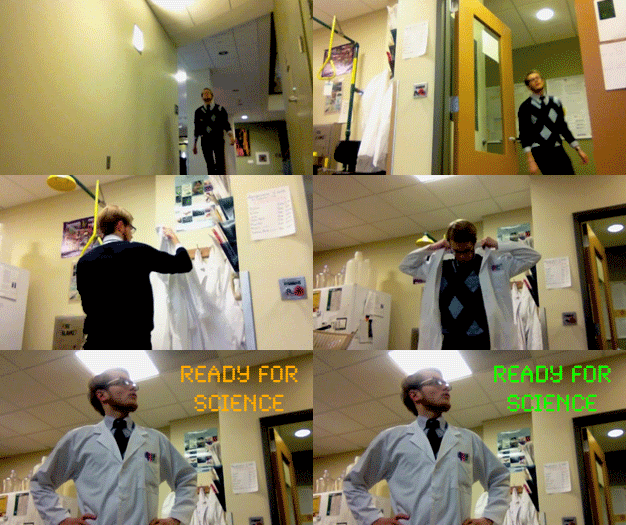
Yeah, so, I'm ready for science.

If I do say so myself, I do look rather badass in this clip. Honestly thought, scientists should be looked up to like super heroes because we're going to be the ones saving the planet (hopefully). More about this topic another day.

Anyway, I've started the phase of my research project that will yield be data. Data for my thesis. Yesssss.

Although my last few videos have been quite long, this one below is short and sweet. How awesome.


My tumblr graphic representing the video >_>


While I still need to plan out all of my assays and assay replicates (to strengthen the power of our collected data), the fact I'm starting this process has me really fired up. For the most part, I'll be running cultures for an hour or so under continuous light (because diatoms like light) under different environmental conditions and taking cell samples periodically for later analysis.

But really, I should be studying for the GRE right now because I take it in less than 3 weeks.

In other brief news:

Last week when I was about to load a gel, I noticed I had a friend. (It's a spider. Click the link!)

In my spare time I put together this Hawk vs. Squirrel video that captures the relationship between the Clark squirrels and the area hawks.

I also updated my Fall @ Clark section, a collection of fall photographs. My most recent additions are at the bottom of the page.

Saturday, October 15, 2011

Diatom Colony Screen

A new lab video!


In this video I discuss designing a colony screen protocol for my transformed lines of diatoms. In one of my recent posts, I posted this picture diagram which oversimplified the process:

While the PCR steps are the same (starting in the top left panel with the diatoms being combined with the PCR mix), I discovered that diatoms grown in liquid culture (i.e. their natural state) needed extra care in preparing them for a colony screen.

Let's step back a bit and quickly talk about colony screens (in case you didn't read my above Tumblr post). A colony screen is a modified PCR reaction*, which is a cyclical amplification of a short sequence of DNA, exponentially copying the targeted DNA strand. (*Even though PCR stands for polymerase chain reaction, PCR is usually said out loud in conversation as PCR reaction.) Often the DNA source for a PCR reaction is a purified, such as plasmid DNA purified by a process to separate plasmid DNA from proteins and genomic DNA.

But colony screens use a colony of cells to supply the DNA for the PCR reaction. By initially lysing the cell by cooking it at a high temperature for a period of time, the cell's DNA is released into the PCR reaction mix and then amplified in the reaction. Colony screens are used to screen cells for the presence of DNA--that is if the targeted sequence of DNA is present, it will be amplified by the reaction. If a reaction gives a positive band on a gel (bottom right of the colony screen chart), then we know that the DNA from the cells in that particular reaction also have the DNA of interest.

This colony screen method should in theory work for other cells, like diatoms. My initial trial successfully amplified GFP from diatom colonies growing on agar plates, but it didn't work for diatom cultures growing in liquid media, a distinction I didn't make at the time.

I soon realized after a failed trial of screening  diatoms solely from liquid cultures that the residual salt water from their growth media was throwing off the delicate chemistry of the PCR reaction. This graphic paired with the above video discusses just this.

Tuesday, October 4, 2011

Fall is creeping around the corner!

...now only if this rain would finally go away so we could enjoy this early fall weather...

Sunday, October 2, 2011

Friday, September 30, 2011

Biology... to be continued?

This completes my second Biology Ph.D. program application. *Crosses fingers*

Wednesday, September 28, 2011

Recent collection of artfully displayed pixels

I've been piling up cool pictures both from lab and campus and wanted to share them with you. They're all in pretty high resolution, so please click on them to see them in their proper, large form.

40 glass culture tubes wait to be inoculated with single colonies of transformed diatoms. Each tape color represents a different gene cassette that was transformed into the diatoms.
A few days ago, my friend Miguel set up an "intertidal" zone in the lobby of the bio building for the Marine Biology class.

A recent panorama of the green on a busy late summer afternoon.
One of the craziest sunsets I've seen in Worcester--taken just two days ago.
I love clouds, especially these ones.
Again, one of the best Worcester sunsets I've seen in ages. This was taken in northern Worcester, about 10 minutes from campus.
Another cool sunset seen from my porch.

Sunday, September 25, 2011

Fluorescence Microscopy, Cricket, stART, & Gene Specific Primers

I uploaded a new video to YouTube this weekend (posted below) chronicling my latest efforts in lab and a few things on life around Clark.


This video touches on:
Since this video was recorded, I've made further steps in my project. In order to test cultures of diatoms sooner for their presence of GFP and at a much higher volume, I've been designing gene specific primers to amplify regions of DNA in the diatoms, that would yield bands of DNA if the GFP is present. There are four main sets of primers I've been designing and will use in PCR experiments:

By using the standard NR-eGFP-NR construct as an example, the sets of primers would like the above picture, where orange highlights show where primers would amplify if the sequence exists in the DNA. Primer (1) would yield segment [a]: a portion of the 5' UTR, eGFP (enhanced GFP), and a portion of the 3' UTR. Primer (2) would yield segment [b], a portion of the 5' UTR and a portion of eGFP; primer (3) would yield a segment [c], portion of eGFP and a portion of the 3' UTR. Primer pairs to amplify the (1, 2, & 3) regions will be made for all of the gene constructs, that is NR-eGFP-NR, NR-eGFP-Actin, NiR-eGFP-NiR, and NiR-eGFP-Actin. Therefore only a specific set of primers will be used per diatom culture, depending on which plasmid it is supposed to have.

All of the plasmid however will be amplified with the fourth and final primer pair. Primer (4) would yield an eGFP segment [d] if the diatom cells had it. This will be the most important primer result out of all of them.

Once we have these primers at hand, I can screen many colonies at once. All I need to do is take a small DNA sample from a colony, add it to a PCR reaction, and run the reaction. I should be able to quickly decipher which colonies have GFP based on an electrophoretic gel.