I've been working on a few YouTube projects here and there and I've finally put the time into making a video... to share them with you? Yeah, a video to share other videos with you. So here it is, and be sure to check back for more biology videos soon!

Thursday, March 24, 2011

Thursday, March 17, 2011

Wednesday, March 16, 2011
Sunday, March 13, 2011
Everybody's working for the weekend? Nope, I'm working through the weekend.

Been putting in a lot of hours on my presentation of a paper for Topics in Marine Biology. I've been juggling this project with a mini presentation in Animal Behavior in addition to some reading. Before tonight is over, I will have re-edited a paper for Animal Behavior, worked more on my mini presentation, adjusted and added content to my Topics presentation, and perhaps worked on my longer Animal Behavior presentation that's for later in the week.
...oh, and I have to do more work for Topics later in the week, which includes more reading and a critical review of a journal article. All in all, my week is going to be very hectic, but I hope to get some fun work in at the end of the week. It's probably safe to say I will not be enjoying my first legal St. Patrick's Day. To be fair, I've never been a big drinker nor celebrator of St. Patty's day. Maybe I'll split a 6-pack of Guinness with my mate down the hall while we study. Responsible and social drinking for the win! :-D
...but now back to the library! Ta for now maties!
Sunday, March 6, 2011
Spring Break -> no classes -> I can update once again
Classes have been killing me.
I haven't been this busy in a long time. It seems like every week is finals week! I haven't been able to catch a break until this week, which is Spring Break. *catches breath* I don't even know where to start because I haven't done a YouTube video in a month or a real post here in weeks.
Well okay, so this week is spring break which is really nice. How am I spending my week off? Well, my friend Jesse from Pennsylvania is coming up to visit for a few days. I'm wicked stoked he's visiting. He's one of my best friends, and I met him in Australia. Jesse and I were in the same study abroad program in Perth, which I've chronicled in my study abroad blog. Besides his visit, it's catch up time for me. Hopefully I can get a head start on the remainder of the semester, which will be nonstop until May 10th or so. Oh boy. Can you tell I'm excited!?
This will be a long post for sure, so please bear with me.

 Over the past few weeks, I've been doing culture practice. Because we will be transforming diatoms on plates (to the right), we need to be determine a protocol for growing diatoms on the plates and transferring them to "native" liquid culture. (The top picture are the plates with a poorly drawn circle within which I plated the diatoms [below]. I had to centrifuge down 40mL of culture for each plate, something like a hundred million cells per plate.) I need a little more practice plating the diatoms in the circle outline, and this will ensure maximum efficiency once we do the actual transformation.
In order to plate the cells, I have to count them like I mentioned before. I can then plate a known estimate of cells, and determine what works best. Once I plated the cells and determined how long they took to grow and how few cells I could plate in order to see cultures grow, I needed to transfer them back into liquid culture. This is just like how I grow bacteria on plates and transfer them into liquid culture. But, because the liquid culture for diatoms are much larger than bacteria cultures I use, we need to start the diatoms off in a very small amount, like a few mL. To do this, I took a wire loop and removed a single colony (several hundred cells) and placed it in a 1.5-3.0mL seawater well, on a 6 well plate, which you can see on the middle right in the picture below.
 After a few days when I got visible growth, I transferred them into a 5 or 10mL culture, seen in the test tubes. By making larger and larger cultures, we can make sure cells are growing well. If we put our initial cells in a half liter flask, it would take up to a week or two to discern whether we got growth or not. But by growing them in small volumes, we can make sure we're doing okay sooner. (In this picture here you can see my four different diatom culture stages: the plated colonies, bottom left; the test tube 5 and 10mL colonies, top left; the 6 well plate containing 1.5 and 3mL colonies, top right; and the trial transformation plates on the bottom right.)

Last but not least, I was finally accepted into the 5th year biology program, which is really exciting! while I had little doubt I would be accepted, getting the official letter was pretty cool and relaxed me a bit. I got my letter last week, months after other 5th year programs decided whether students could continue their projects or not.

A side from reading what I consider to be a lot of papers on different aspects of animal behavior, we're slowly starting to begin our research projects. We have half a semester to collect as much data as possible, write a sophisticated lab report/research paper, and create a lengthy presentation and poster. Something tells me it's going to be an incredible crunch, which is why I'm so eager to get as much studying done as possible this week.
My research project along with a few friends is to investigate foraging competition among threespine stickleback juveniles, which we call fry. The biggest lab on campus uses threespine stickleback for an array of studies, mostly concerned with evolution and adaptive radiation. But yeah, our project. We're looking into whether body size affects how well stickleback fry can compete for food. In ponds and lakes with limited food sources, competition is likely to be high and we're curious if size is an advantage.
 To look at this, we'll be feeding pairs stickleback fry limited amounts of bloodworms, and record their competitions. We do this by pipetting bloodworms into a small tank, and videotaping the fish activity. We can then go back and watch their interactions and analyze it.
 However, in order to get them to be competitive, we have to make sure they're hungry... so we don't feed them for half a day before testing.
I haven't been this busy in a long time. It seems like every week is finals week! I haven't been able to catch a break until this week, which is Spring Break. *catches breath* I don't even know where to start because I haven't done a YouTube video in a month or a real post here in weeks.
Well okay, so this week is spring break which is really nice. How am I spending my week off? Well, my friend Jesse from Pennsylvania is coming up to visit for a few days. I'm wicked stoked he's visiting. He's one of my best friends, and I met him in Australia. Jesse and I were in the same study abroad program in Perth, which I've chronicled in my study abroad blog. Besides his visit, it's catch up time for me. Hopefully I can get a head start on the remainder of the semester, which will be nonstop until May 10th or so. Oh boy. Can you tell I'm excited!?
This will be a long post for sure, so please bear with me.
Directed study

 Over the past few weeks, I've been doing culture practice. Because we will be transforming diatoms on plates (to the right), we need to be determine a protocol for growing diatoms on the plates and transferring them to "native" liquid culture. (The top picture are the plates with a poorly drawn circle within which I plated the diatoms [below]. I had to centrifuge down 40mL of culture for each plate, something like a hundred million cells per plate.) I need a little more practice plating the diatoms in the circle outline, and this will ensure maximum efficiency once we do the actual transformation.
In order to plate the cells, I have to count them like I mentioned before. I can then plate a known estimate of cells, and determine what works best. Once I plated the cells and determined how long they took to grow and how few cells I could plate in order to see cultures grow, I needed to transfer them back into liquid culture. This is just like how I grow bacteria on plates and transfer them into liquid culture. But, because the liquid culture for diatoms are much larger than bacteria cultures I use, we need to start the diatoms off in a very small amount, like a few mL. To do this, I took a wire loop and removed a single colony (several hundred cells) and placed it in a 1.5-3.0mL seawater well, on a 6 well plate, which you can see on the middle right in the picture below.


After break, my professor and I hope to travel down to Rhode Island and transform my diatoms. I can't wait to finally move forward with this project! I'm hoping my post-transformation project will really speed up and I can start collecting data and maybe publish something!
Animal Behavior

A side from reading what I consider to be a lot of papers on different aspects of animal behavior, we're slowly starting to begin our research projects. We have half a semester to collect as much data as possible, write a sophisticated lab report/research paper, and create a lengthy presentation and poster. Something tells me it's going to be an incredible crunch, which is why I'm so eager to get as much studying done as possible this week.
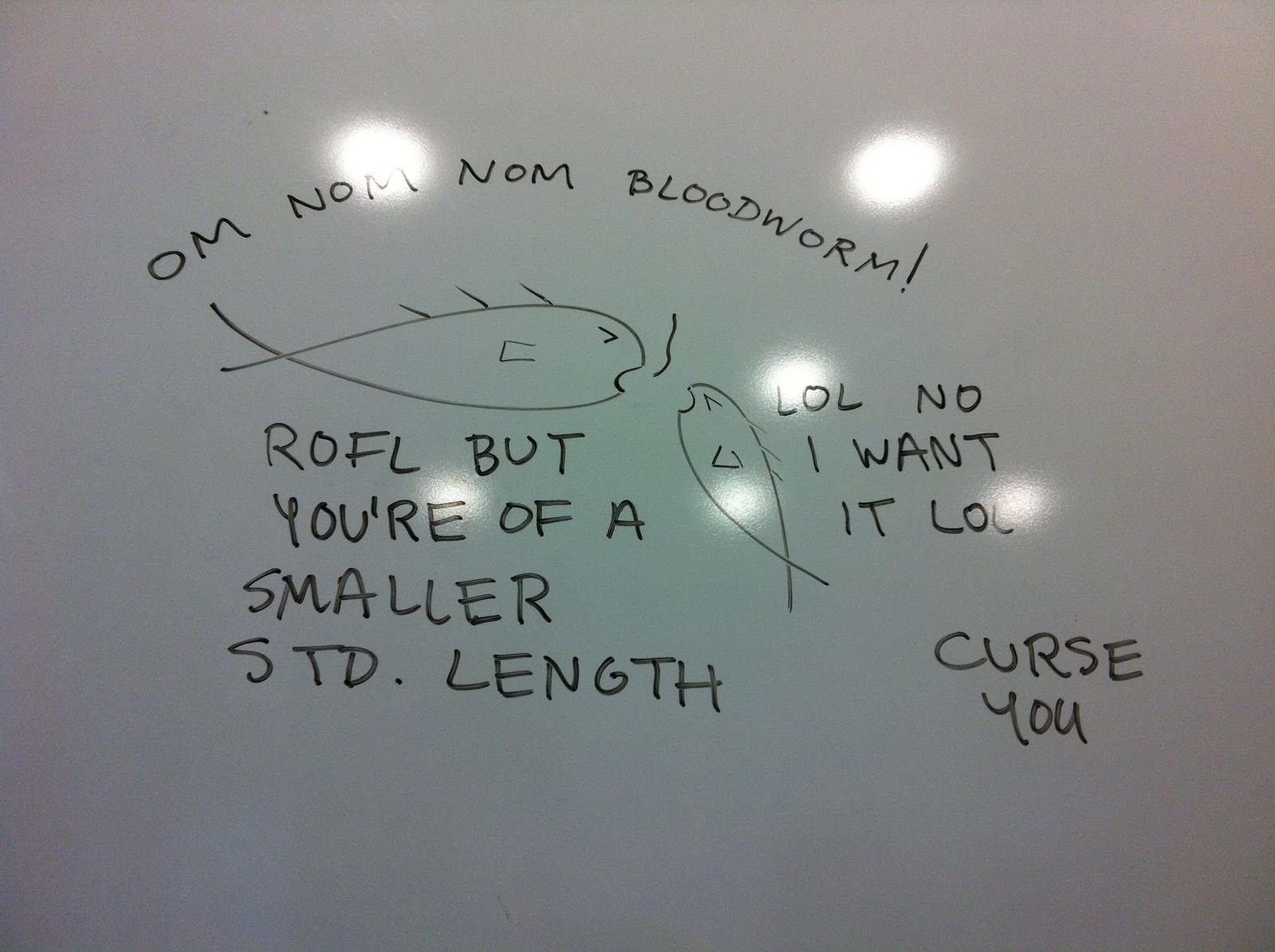 |
| Something I drew on a whiteboard during class... |


Sunday, February 20, 2011
Stories Through Pictures
This is not a tumblr, nor do I intend it to be. However, I have to admit I really like blogs that say a lot with a single photo and a quick caption. I've been meaning to update nearly every day in this manner if I didn't have time to write more, but I've been so busy with everything that I haven't even had to do just that!
Today, I had this to post.

Today, I had this to post.

Stuck in the library on a Sunday afternoon.

Unfortunately it was already getting dark,
so it's hard to see the poor squirrel being slowly ripped apart!
 Geoff Rickly, center, has the most amazing live voice I've ever heard. He's also
super, super nice in person. (Took this picture myself with my iPhone :-p)
 My night was complete with a quick snapshot with Jag, the lead singer
of A Skylit Drive. I asked him to make a funny face ^,^

That place of course is my favorite place on campus to take pictures of, just outside of the AC. (I got myself an app on my iPhone to put cute little filters on my photos. Now I can be a hipster too!)
On my way back from the library, I saw my friend Elena checking out yet another hawk eating a squirrel. (Elena, a student from Russia, has a set of English and Russian blogs here.)
On my way back from the library, I saw my friend Elena checking out yet another hawk eating a squirrel. (Elena, a student from Russia, has a set of English and Russian blogs here.)

so it's hard to see the poor squirrel being slowly ripped apart!
On Friday night, I saw two of my favorite bands in concert at the Palladium: A Skylit Drive and Thursday. Unfortunately, A Skylit Drive only had a 30-minute set, which wasn't long enough to cover all of my favorite songs. Even though Thursday, shown below, had a longer set, they only played one of their older albums (Full Collapse), which I am not as familiar with. Even still, it was a great night to say the least.

super, super nice in person. (Took this picture myself with my iPhone :-p)

of A Skylit Drive. I asked him to make a funny face ^,^
This past week was highlighted by several gorgeous early spring days.

Too bad it's going to snow again this week! Oh nooooooes!
Sunday, February 13, 2011
Midi Preps & Stickleback Tanks
I had a fairly productive week, hence my lack of posts for 6 days!
In the lab I did a Midi prep of my Actin and NR plasmids. LOL WUT? -- Okay, so, a Midi prep is a higher scale preparation of plasmids from bacteria cells, which therefore yields more plasmid DNA than the Mini preps I've done in the past. While it's great that Midi preps yield more DNA for my experiments, they're definitely more tricky and take longer to set up.
 Essentially, I have an array of plasmids at my disposal that will help us look at different genes associated with nitrogen assimilation. As I've said before, these plasmids have a promoter (Pnr), an open reading frame (ORF; gene), and a terminator (Tnr). For the most part, the ORF is the green fluorescent protein (GFP), which we use as a reporter (if the Pnr–and to some extent the Tnr–are working in the cell, GFP will be expressed and the cell will glow, which is easily seen!). The parts of the plasmids we have been changing around are the Pnr and Tnr regions of different nitrogen assimilation genes used in diatoms. The plasmid I made has the Pnr from NR (nitrate reductase) and the Tnr from Actin, which has no role in nitrogen assimilation. We can than compare the activity of GFP in vivo (in the cell) between diatoms that have the NR Tnr and Actin Tnr. If there are any differences, this would suggest that NR is regulated at the 3' UTR (at the end of the ORF) based on environmental conditions.
So these Midi preps I did this week yielded me a significantly higher amount of plasmids, and I'll be using them to transform my diatoms. In order to do a Midi prep, I had to do a series of bacteria cultures that grow over night in out 37°C room. To start, I did what's called a glycerol stock streak. That is, I took 2 cultures stored in glycerol at -80°C and streaked them onto agar media plates. They grew overnight, and the next day I took a single colony from the plates that grew over night and mixed them into 5mL of liquid media in a test tube. Those guys then grew overnight, and on the third day I took a very small volume of them and poured it into 50mL liquid media in a beaker. Yeah, and then that beaker also grew overnight. In all, it takes three overnight cultures (glycerol stock on a plate, starter liquid culture, final liquid culture) to get what I needed for the Midi prep.
I took the 50mL of liquid bacteria culture (which is 16x the amount I used for a Mini prep) into the Midi prep, which after a first spin down of the cells, was a series of adding different solutions and filtering them through specialized syringes. The Midi prep uses cell and DNA chemistry to isolate the plasmid DNA through a series of steps. It's pretty neat! Because this was my first run (which I did with my professor), it was a little slow and took some getting used to. It definitely helps to have an extra set of hands, but I think I'll be able to do it okay on my own next time.
I did a grow up of bacteria cells containing both my NR and Actin plasmids and ran them through the Midi prep. From here, I'll most likely precipitate them and resuspend them into less liquid so they're at higher concentrations. These plasmids will then be used in my transformations. In addition to prepping these plasmids for transformation, I need to track down the plasmids with resistance to antibiotics. They're already prepped and stored in our freezer. These plasmids will be transformed along with the nitrogen plasmids, and will allow for us to select for diatom cells that have antibiotic resistance.
In other news, I got First Academic honors for last semester.
 Niccccce! That's relatively exciting.

In the lab I did a Midi prep of my Actin and NR plasmids. LOL WUT? -- Okay, so, a Midi prep is a higher scale preparation of plasmids from bacteria cells, which therefore yields more plasmid DNA than the Mini preps I've done in the past. While it's great that Midi preps yield more DNA for my experiments, they're definitely more tricky and take longer to set up.
 Essentially, I have an array of plasmids at my disposal that will help us look at different genes associated with nitrogen assimilation. As I've said before, these plasmids have a promoter (Pnr), an open reading frame (ORF; gene), and a terminator (Tnr). For the most part, the ORF is the green fluorescent protein (GFP), which we use as a reporter (if the Pnr–and to some extent the Tnr–are working in the cell, GFP will be expressed and the cell will glow, which is easily seen!). The parts of the plasmids we have been changing around are the Pnr and Tnr regions of different nitrogen assimilation genes used in diatoms. The plasmid I made has the Pnr from NR (nitrate reductase) and the Tnr from Actin, which has no role in nitrogen assimilation. We can than compare the activity of GFP in vivo (in the cell) between diatoms that have the NR Tnr and Actin Tnr. If there are any differences, this would suggest that NR is regulated at the 3' UTR (at the end of the ORF) based on environmental conditions.
 |
| The control plasmid, with both an NR Pnr and Tnr. |
 |
| The Actin plasmid I constructed with the Actin Tnr |
I took the 50mL of liquid bacteria culture (which is 16x the amount I used for a Mini prep) into the Midi prep, which after a first spin down of the cells, was a series of adding different solutions and filtering them through specialized syringes. The Midi prep uses cell and DNA chemistry to isolate the plasmid DNA through a series of steps. It's pretty neat! Because this was my first run (which I did with my professor), it was a little slow and took some getting used to. It definitely helps to have an extra set of hands, but I think I'll be able to do it okay on my own next time.
I did a grow up of bacteria cells containing both my NR and Actin plasmids and ran them through the Midi prep. From here, I'll most likely precipitate them and resuspend them into less liquid so they're at higher concentrations. These plasmids will then be used in my transformations. In addition to prepping these plasmids for transformation, I need to track down the plasmids with resistance to antibiotics. They're already prepped and stored in our freezer. These plasmids will be transformed along with the nitrogen plasmids, and will allow for us to select for diatom cells that have antibiotic resistance.
In other news, I got First Academic honors for last semester.


In other other news, we're starting our behavior experiment projects in Animal Behavior. On Thursday, we ran some very rudimentary experiments and set up our tanks for our Threespine Stickleback. We're going to be investigating foraging competition (competing for food) and hopefully get some cool results. Looks like we'll have to "starve" our fish long enough for them to be hungry. We want them to compete for food, not leisurely eat the tiny little worms we drop into the tank! It'll be interesting to see how our project progresses. Admittedly this project will add to stress during my week, and force me to get a lot more work done on the weekends. I no longer can have leisurely Saturdays! Good think getting a lot of work done makes me feel really good!
Sunday, February 6, 2011
Counting cells and taking names
I spent a good portion of Friday morning and early afternoon in lab doing some work and figuring out where to go next in my project. I talked about different kinds of reporter plasmids we may use in this project with my professor (we may incorporate other genes that have plasmids already made) in addition to what kind of antibiotics we're going to use.
 Two types of antibiotics have been used in recent projects transforming diatoms: nourseothricin and zeocin. The former is 100 times less toxic than the former, so we're going to start with using that. Right now we're growing the plasmids without any selection pressures (no antibiotics). After we get a feel for how well the cells grow on the agar plates, we'll test them with nourseothricin. First of all, we need to make sure nourseothricin kills our diatom cells. This way once we transform them with our plasmids (which will include the anti-nourseothricin plasmid, nat), we'll know that only diatoms that have been transformed with nat will survive when exposed to nourseothricin.
In order to grow the diatom culture on an agar plate, I had to count them first. This entails pipetting a small amount of diatom liquid culture onto a hemocytometer, which is essentially a microscope slide with gridlines on it. The hemocytometer allows us to estimate the number of cells per milliliter. That way we can know about how many diatom cells we're putting into a fresh culture or agar plate. I'll have to get a hold of a special camera or something so I can take pictures of what I see on the microscope!
 Once I counted my cells, I plated four different amounts on four different plates. This way, we can see how different starting amounts of cells affects how they grow. These cultures will take up to a week or so to grow, so I'll have to find something else to keep myself occupied in the lab in the meantime! :-p
After they've grown up a bit, I'll start testing the nourseothricin on the cells like I mentioned above. We could do this by soaking paper discs (about the size of hole punches) with antibiotics, or spreading antibiotics on a plate and then growing them.
I talk about all of this stuff in my video blog post below:
Outside of the lab, in the so called real world, we've been having a slight thaw. This has been warmly welcomed on campus. It rained most of the day yesterday and today it is in the mid 30's. I was wondering to myself the other day what would happen if temperatures jumped up into the 60's for two or three days. All of this snow... would lead to massive flooding. How awesome would that be!?
 Two types of antibiotics have been used in recent projects transforming diatoms: nourseothricin and zeocin. The former is 100 times less toxic than the former, so we're going to start with using that. Right now we're growing the plasmids without any selection pressures (no antibiotics). After we get a feel for how well the cells grow on the agar plates, we'll test them with nourseothricin. First of all, we need to make sure nourseothricin kills our diatom cells. This way once we transform them with our plasmids (which will include the anti-nourseothricin plasmid, nat), we'll know that only diatoms that have been transformed with nat will survive when exposed to nourseothricin.
In order to grow the diatom culture on an agar plate, I had to count them first. This entails pipetting a small amount of diatom liquid culture onto a hemocytometer, which is essentially a microscope slide with gridlines on it. The hemocytometer allows us to estimate the number of cells per milliliter. That way we can know about how many diatom cells we're putting into a fresh culture or agar plate. I'll have to get a hold of a special camera or something so I can take pictures of what I see on the microscope!
 Once I counted my cells, I plated four different amounts on four different plates. This way, we can see how different starting amounts of cells affects how they grow. These cultures will take up to a week or so to grow, so I'll have to find something else to keep myself occupied in the lab in the meantime! :-p
After they've grown up a bit, I'll start testing the nourseothricin on the cells like I mentioned above. We could do this by soaking paper discs (about the size of hole punches) with antibiotics, or spreading antibiotics on a plate and then growing them.
I talk about all of this stuff in my video blog post below:
Outside of the lab, in the so called real world, we've been having a slight thaw. This has been warmly welcomed on campus. It rained most of the day yesterday and today it is in the mid 30's. I was wondering to myself the other day what would happen if temperatures jumped up into the 60's for two or three days. All of this snow... would lead to massive flooding. How awesome would that be!?
Wednesday, February 2, 2011
Snow: round 5,000
The snow continues to fall in Worcester. But life must go on.

 On Monday I finished making stock solutions for my diatom media. As opposed to a lot of bacteria which can grow off of plain LB broth, I had to make a special media with a specific balance of chemicals to support diatom growth. For the most part, I mixed minute volumes of powders to tubes of water, a total of 10 different solutions. I took only 0.5-1% of each solution and added it to a solution of artificial seawater (water and salts). This solution was then autoclaved separately from an agar solution. When combined, the seawater and agar solution made solidified diatom seawater agar plates, upon which I can grow my diatoms. I'll use these to transform my diatoms on in the near future.
I chronicled these recent efforts in the YouTube post below (be sure to check it out, because there's a really cool bonus video at the end which may or may not include a hawk eating a squirrel).
I hope to continue my forward lab momentum and start spreading diatom cells on my plates soon to let them grow up. From there I hope it's setting up a meeting with some lab folks down in RI about transforming some diatoms. Hey! This project is about to take off!
Outside of the lab, I'm trying to stay on track in Topics in Marine Biology (reading and annotating scientific literature), Ecology (trying to remember how Excel works in order to analyze data) and Animal Behavior (where I hope to start our research projects soon with Three-spined Stickleback). I also need to keep the motion going with ROCU, Clark's radio program which I run with a few of my friends. Today's only Wednesday, which leaves me with a long day of classes on Thursday and a day to catch up in lab and work on Friday before the weekend. Cheers for now!

Classes have been canceled left and right here on campus, but for the most part I've had every single class thus far. However, that stream came to an awkward close today, when my professor goofed and forgot to attach the class e-mail list when e-mailing us that class was canceled (only one student got the e-mail). No one ended up coming to Conservation Biology, the class I'm auditing, either. Come 2:00, both of my classes were "done" for the day, but I had yet to get any real work done, which was kind of a bummer. I guess next freak storm we have I'll know better to just assume that even I can have classes canceled, and to just to go the library instead.
 On Monday I finished making stock solutions for my diatom media. As opposed to a lot of bacteria which can grow off of plain LB broth, I had to make a special media with a specific balance of chemicals to support diatom growth. For the most part, I mixed minute volumes of powders to tubes of water, a total of 10 different solutions. I took only 0.5-1% of each solution and added it to a solution of artificial seawater (water and salts). This solution was then autoclaved separately from an agar solution. When combined, the seawater and agar solution made solidified diatom seawater agar plates, upon which I can grow my diatoms. I'll use these to transform my diatoms on in the near future.
I hope to continue my forward lab momentum and start spreading diatom cells on my plates soon to let them grow up. From there I hope it's setting up a meeting with some lab folks down in RI about transforming some diatoms. Hey! This project is about to take off!
Outside of the lab, I'm trying to stay on track in Topics in Marine Biology (reading and annotating scientific literature), Ecology (trying to remember how Excel works in order to analyze data) and Animal Behavior (where I hope to start our research projects soon with Three-spined Stickleback). I also need to keep the motion going with ROCU, Clark's radio program which I run with a few of my friends. Today's only Wednesday, which leaves me with a long day of classes on Thursday and a day to catch up in lab and work on Friday before the weekend. Cheers for now!
Subscribe to:
Posts (Atom)